
Ghana
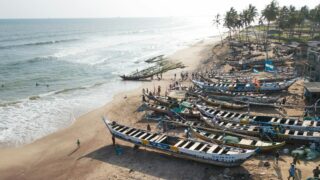
Prapram, Ghana; The ArtboardGH @ Unsplash
Rooted in Nature, Investing in People
Ghana, West Africa’s second-largest economy after Nigeria, has experienced significant political and economic transformation over recent decades. Following a history of alternating civilian and military governments, the country has maintained democratic rule under the Fourth Republic since 1993. Rich in natural resources (with cocoa being a primary commodity), Ghana has traditionally relied on commodity exports, although it has increasingly diversified into digital technologies and services. Despite facing a severe economic crisis in 2022, Ghana has remained committed to advancing sustainable development and green growth.
Climate action in Ghana is guided primarily by the National Climate Change Policy (NCCP), published in 2013, which links environmental sustainability with economic development. While the policy has not undergone significant updates and the country lacks a comprehensive green economy strategy, climate objectives have been increasingly integrated into national and local planning through its NDC and SDG commitments. In April 2025, Ghana launched West Africa’s largest floating solar project as part of efforts to increase renewable energy’s share of the energy mix to 10% by 2030. Fiscal reforms have also strengthened the government’s ability to private green finance.
Ghana performs particularly strongly in the area of nature and environmental stewardship. The country has advanced natural capital accounting through government-led ecosystem and ecosystem services assessments, helping to inform biodiversity conservation and spatial planning. These efforts are supported by a long-term accounting framework and improved coordination across government agencies. Nevertheless, Ghana continues to face significant environmental challenges, including deforestation, land degradation, and pollution linked to illegal mining, logging, and agricultural expansion. In response, the government has intensified efforts to restore degraded landscapes, strengthen forest management, and combat illegal mining activities.
Ghana is also excelling when it comes to green jobs and just transition policies. Through its Green Jobs Strategy (2021 - 2025) and the National Energy Transition Framework, the government has placed job creation, skills development, and inclusive growth at the centre of its sustainability agenda. A national Green Jobs Assessment conducted in 2024 established the country’s first baseline for green employment and demonstrated the potential for climate policies to generate jobs, stimulate economic growth and reduce emissions.
However, progress on clean energy remains more limited. Although Ghana's Renewable Energy Master Plan (2019–2030) and Renewable Energy Act provide a framework for expanding renewable generation, the country's targets remain relatively modest. Ghana's updated NDC commits to increasing renewable energy penetration by approximately 10% by 2030, while longer-term strategies outline ambitions for greater deployment without establishing binding implementation pathways. As a result, renewable energy expansion continues to lag behind the scale required for a more rapid energy transition.
Overall, Ghana is demonstrating a growing commitment to integrating sustainability into its development model. However, the absence of an updated overarching green economy strategy alongside macroeconomic challenges, environmental degradation and relatively modest clean energy ambitions suggests that further policy ambition and implementation will be needed if the country is to achieve a truly transformative green transition.
Prapram, Ghana; The ArtboardGH @ Unsplash
Policy Scores
Last updated 24 Apr 2026
Governance
National Green Economy Planning
Ghana’s National Climate Change Policy (NCCP) (published in 2013) provides an overarching framework linking climate action to development and green economy opportunities, and Ghana’s updated NDC (2020–2030) sets out a relatively detailed package of mitigation and adaptation measures with costs and conditional/unconditional elements. The NCCP has not undergone substantive updates since its release, making it an older guiding document. However, the key implementation instrument commonly referenced for cross-sector action programming, the National Climate Change Master Plan (2015–2020), is outdated. Ghana has initiated, but not yet completed, the development of a Long-Term Low Emissions Development Strategy (LT LEDS), meaning a current replacement for the Master Plan is still pending. Furthermore, Ghana’s long-term net-zero framing in recent official reporting is anchored in national energy transition planning that targets net-zero emissions by approximately 2060–2070, including the National Energy Transition Framework (2022–2070), indicating that long-term ambition is not aligned with a net-zero-by-2050 green economy plan.
Ghana’s National Climate Change Policy (NCCP) (published in 2013) provides an overarching framework linking climate action to development and green economy opportunities, and Ghana’s updated NDC (2020–2030) sets out a relatively detailed package of mitigation and adaptation measures with costs and conditional/unconditional elements. The NCCP has not undergone substantive updates since its release, making it an older guiding document. However, the key implementation instrument commonly referenced for cross-sector action programming, the National Climate Change Master Plan (2015–2020), is outdated. Ghana has initiated, but not yet completed, the development of a Long-Term Low Emissions Development Strategy (LT LEDS), meaning a current replacement for the Master Plan is still pending. Furthermore, Ghana’s long-term net-zero framing in recent official reporting is anchored in national energy transition planning that targets net-zero emissions by approximately 2060–2070, including the National Energy Transition Framework (2022–2070), indicating that long-term ambition is not aligned with a net-zero-by-2050 green economy plan.
Inclusive Corporate Governance
Ghana has a national corporate governance framework that recognises inclusive governance and sustainability, including references to stakeholder (including employee) interests, diversity and inclusion, and alignment with global sustainability goals through the National Corporate Governance Code. This Code promotes responsible corporate citizenship, encourages boards to consider environmental and social impacts, and aligns good governance with national development objectives. However, the National Corporate Governance Code operates as a principles‑based (‘soft law’) instrument rather than a mandatory regime, and therefore provides guidance rather than enforceable requirements. At the capital‑market level, the SEC Corporate Governance Code for Listed Companies (2020) similarly requires boards to promote long-term sustainable value creation and to have regard for employees and other stakeholders. Beyond core governance rules, Ghana has made progress on ESG integration and inclusion, particularly through financial-sector regulation and policy guidance. The Bank of Ghana Sustainable Banking Principles (2019) embed ESG considerations into lending and risk management, explicitly include gender equality, and frame sustainable finance as a contribution to achieving the SDGs. However, Ghana does not have a mandatory, nationwide legal framework requiring employee representation on company boards or binding gender-balance quotas. While some sector-specific rules exist, such as the Bank of Ghana directive for rural and community banks requiring at least one female director, these are limited in scope and not part of a unified national strategy for mandatory inclusive governance standards.
Ghana has a national corporate governance framework that recognises inclusive governance and sustainability, including references to stakeholder (including employee) interests, diversity and inclusion, and alignment with global sustainability goals through the National Corporate Governance Code. This Code promotes responsible corporate citizenship, encourages boards to consider environmental and social impacts, and aligns good governance with national development objectives. However, the National Corporate Governance Code operates as a principles‑based (‘soft law’) instrument rather than a mandatory regime, and therefore provides guidance rather than enforceable requirements. At the capital‑market level, the SEC Corporate Governance Code for Listed Companies (2020) similarly requires boards to promote long-term sustainable value creation and to have regard for employees and other stakeholders. Beyond core governance rules, Ghana has made progress on ESG integration and inclusion, particularly through financial-sector regulation and policy guidance. The Bank of Ghana Sustainable Banking Principles (2019) embed ESG considerations into lending and risk management, explicitly include gender equality, and frame sustainable finance as a contribution to achieving the SDGs. However, Ghana does not have a mandatory, nationwide legal framework requiring employee representation on company boards or binding gender-balance quotas. While some sector-specific rules exist, such as the Bank of Ghana directive for rural and community banks requiring at least one female director, these are limited in scope and not part of a unified national strategy for mandatory inclusive governance standards.
Participatory Policymaking
The 1992 Constitution and the Right to Information Act (2019) establish a clear right for citizens to participate in governance and access information. In practice, Ghana frequently conducts multi stakeholder engagement for high level strategies, such as the 2025 Voluntary National Review for the Sustainable Development Goals and the National Development Planning Commission’s national and sub national planning frameworks. These processes regularly include civil society, youth groups, and the private sector. Furthermore, the Environmental Assessment Regulations (L.I. 1652) mandate public hearings and consultations for projects with significant environmental impacts, often requiring these to be conducted in local languages to ensure community understanding. However, while consultations are common for specific environmental projects or major national reviews, there is no legal mandate requiring a comprehensive social impact assessment for all legislation or general public policy. Participation is regular but uneven, and at times influenced by external partners rather than fully institutionalised across government. While the National Decentralisation Policy (2026–2030) aims to deepen the inclusion of women and persons with disabilities at the local level through Gender, Disability, and Social Inclusion (GEDSI) frameworks, these initiatives are still in the early stages. Marginalized groups, particularly indigenous and rural communities, often face barriers such as high illiteracy and limited access to digital consultation platforms.
The 1992 Constitution and the Right to Information Act (2019) establish a clear right for citizens to participate in governance and access information. In practice, Ghana frequently conducts multi stakeholder engagement for high level strategies, such as the 2025 Voluntary National Review for the Sustainable Development Goals and the National Development Planning Commission’s national and sub national planning frameworks. These processes regularly include civil society, youth groups, and the private sector. Furthermore, the Environmental Assessment Regulations (L.I. 1652) mandate public hearings and consultations for projects with significant environmental impacts, often requiring these to be conducted in local languages to ensure community understanding. However, while consultations are common for specific environmental projects or major national reviews, there is no legal mandate requiring a comprehensive social impact assessment for all legislation or general public policy. Participation is regular but uneven, and at times influenced by external partners rather than fully institutionalised across government. While the National Decentralisation Policy (2026–2030) aims to deepen the inclusion of women and persons with disabilities at the local level through Gender, Disability, and Social Inclusion (GEDSI) frameworks, these initiatives are still in the early stages. Marginalized groups, particularly indigenous and rural communities, often face barriers such as high illiteracy and limited access to digital consultation platforms.
Beyond GDP
The Ghana Statistical Service and the National Development Planning Commission compile selected accounts and indicators that measure aspects of human, social, and natural capital. Specifically, in 2025, Ghana released its first National Productivity Statistics Report covering labour and multifactor productivity trends from 1991–2022. The country has also compiled Land and Ecosystem Extent Accounts and Ecosystem Services Accounts for 2015–2021. However, integration of these metrics into the national planning and budgetary cycle remains in early phases. While the 2025 Voluntary National Review and the Medium Term National Development Policy Framework (2022–2025) emphasize inclusive growth and climate resilience, GDP growth and fiscal consolidation under IMF supported programmes continue to serve as the primary anchors for high level decision making. The government has begun preparing guidelines to mainstream natural capital and biodiversity into development planning at sub national levels.
The Ghana Statistical Service and the National Development Planning Commission compile selected accounts and indicators that measure aspects of human, social, and natural capital. Specifically, in 2025, Ghana released its first National Productivity Statistics Report covering labour and multifactor productivity trends from 1991–2022. The country has also compiled Land and Ecosystem Extent Accounts and Ecosystem Services Accounts for 2015–2021. However, integration of these metrics into the national planning and budgetary cycle remains in early phases. While the 2025 Voluntary National Review and the Medium Term National Development Policy Framework (2022–2025) emphasize inclusive growth and climate resilience, GDP growth and fiscal consolidation under IMF supported programmes continue to serve as the primary anchors for high level decision making. The government has begun preparing guidelines to mainstream natural capital and biodiversity into development planning at sub national levels.
Finance
Green Finance & Banking
Ghana is demonstrating some progress on green financial reform. The Bank of Ghana’s Climate-Related Financial Risk Directive, issued in 2024, mandated that all regulated financial institutions integrate climate-related risks into their governance, risk management, and public disclosures by December 31, 2025. This transition is supported by the Ghana Green Finance Taxonomy, developed by the Ministry of Finance. Compliance with the Ghana Sustainable Banking Principles has seen a significant upward trend, rising from 42% in 2021 to over 73% by early 2025. Furthermore, the establishment of the Climate and Sustainability Office within the central bank ensures oversight and capacity-building. The expansion of the taxonomy to include carbon-intensive transition sectors like mining and oil is scheduled for 2026.
Ghana is demonstrating some progress on green financial reform. The Bank of Ghana’s Climate-Related Financial Risk Directive, issued in 2024, mandated that all regulated financial institutions integrate climate-related risks into their governance, risk management, and public disclosures by December 31, 2025. This transition is supported by the Ghana Green Finance Taxonomy, developed by the Ministry of Finance. Compliance with the Ghana Sustainable Banking Principles has seen a significant upward trend, rising from 42% in 2021 to over 73% by early 2025. Furthermore, the establishment of the Climate and Sustainability Office within the central bank ensures oversight and capacity-building. The expansion of the taxonomy to include carbon-intensive transition sectors like mining and oil is scheduled for 2026.
Greening Fiscal & Monetary Policy
Ghana has put in place key building blocks for integrating environmental sustainability into public finance and financial sector policy, but these are not yet applied through a systemic approach. The Ministry of Finance has introduced climate budget tagging (CLIMFINTRACK) to track climate-related spending, though implementation consistency and a clearly budget-anchored climate finance strategy remain limited. The Bank of Ghana’s Sustainable Banking Principles and the SEC’s Green Bond Guidelines provide frameworks for managing environmental risk and supporting green finance.
Ghana has put in place key building blocks for integrating environmental sustainability into public finance and financial sector policy, but these are not yet applied through a systemic approach. The Ministry of Finance has introduced climate budget tagging (CLIMFINTRACK) to track climate-related spending, though implementation consistency and a clearly budget-anchored climate finance strategy remain limited. The Bank of Ghana’s Sustainable Banking Principles and the SEC’s Green Bond Guidelines provide frameworks for managing environmental risk and supporting green finance.
Green Trade Practices
Ghana shows targeted but limited integration of environmental priorities into its trade policy. The strongest example is its EU Voluntary Partnership Agreement under the FLEGT framework, with the launch of FLEGT licensing in 2025, which links forest governance standards to timber exports to the EU. However, this mechanism is sector-specific and does not amount to broad green trade integration across the economy. In wider trade agreements, such as the UK–Ghana Interim Trade Partnership Agreement, sustainable development language exists but does not clearly establish enforceable provisions. Domestically, Ghana has introduced supportive elements, including a Green Finance Taxonomy and an Article 6 carbon market framework. However, the repeal of the Emissions Levy Act in 2025 indicates that carbon pricing architecture is not yet stable enough.
Ghana shows targeted but limited integration of environmental priorities into its trade policy. The strongest example is its EU Voluntary Partnership Agreement under the FLEGT framework, with the launch of FLEGT licensing in 2025, which links forest governance standards to timber exports to the EU. However, this mechanism is sector-specific and does not amount to broad green trade integration across the economy. In wider trade agreements, such as the UK–Ghana Interim Trade Partnership Agreement, sustainable development language exists but does not clearly establish enforceable provisions. Domestically, Ghana has introduced supportive elements, including a Green Finance Taxonomy and an Article 6 carbon market framework. However, the repeal of the Emissions Levy Act in 2025 indicates that carbon pricing architecture is not yet stable enough.
Pricing Carbon
Ghana briefly introduced explicit carbon pricing through the Emissions Levy Act (Act 1112), implemented in 2024, but repealed it in 2025. As a result, Ghana does not currently operate a national carbon tax or emissions trading system. Instead, Ghana has focused on enabling participation in international carbon markets under Article 6, including registry and institutional frameworks. However, these mechanisms do not substitute for a domestic compliance carbon price. Ghana also lacks a binding national carbon budget framework .
Ghana briefly introduced explicit carbon pricing through the Emissions Levy Act (Act 1112), implemented in 2024, but repealed it in 2025. As a result, Ghana does not currently operate a national carbon tax or emissions trading system. Instead, Ghana has focused on enabling participation in international carbon markets under Article 6, including registry and institutional frameworks. However, these mechanisms do not substitute for a domestic compliance carbon price. Ghana also lacks a binding national carbon budget framework .
Sectors
Cross-Sectoral Planning
The National Climate Change Policy (2013), Updated NDC (2021), and National Energy Transition Framework (2022–2023) provide economy wide and sector specific direction, while the National Development Planning Commission integrates sustainability into medium term development planning. Coordination occurs through inter ministerial and multi stakeholder mechanisms, including the National Climate Change Committee and the National Energy Transition Implementation Committee, and in 2025 Ghana strengthened the statutory role of the Environmental Protection Authority (formerly the Agency) in overseeing climate related matters through the Environmental Protection Act, 2025 (Act 1124). However, while sectoral coverage is broad, policy integration and monitoring remain uneven, and long term strategy development is still evolving.
The National Climate Change Policy (2013), Updated NDC (2021), and National Energy Transition Framework (2022–2023) provide economy wide and sector specific direction, while the National Development Planning Commission integrates sustainability into medium term development planning. Coordination occurs through inter ministerial and multi stakeholder mechanisms, including the National Climate Change Committee and the National Energy Transition Implementation Committee, and in 2025 Ghana strengthened the statutory role of the Environmental Protection Authority (formerly the Agency) in overseeing climate related matters through the Environmental Protection Act, 2025 (Act 1124). However, while sectoral coverage is broad, policy integration and monitoring remain uneven, and long term strategy development is still evolving.
Circular Economy
Ghana has taken initial steps toward circular economy implementation, particularly through the Ghana Circular Economy Centre established under MESTI in partnership with UNIDO. The initiative supports circular entrepreneurship and technology piloting in sectors such as plastics, textiles and agriculture. Sectoral policy is evident in the National Plastics Management Policy and measures on plastic alternatives, as well as the 2023 Green Minerals Policy, which promotes domestic value addition for critical minerals rather than a full circular economy framework. However, implementation gaps persist in coordination, monitoring and local execution. Ghana does not yet have an integrated, economy-wide circular economy roadmap with binding circular procurement rules, repair rights, or explicit material use reduction targets.
Ghana has taken initial steps toward circular economy implementation, particularly through the Ghana Circular Economy Centre established under MESTI in partnership with UNIDO. The initiative supports circular entrepreneurship and technology piloting in sectors such as plastics, textiles and agriculture. Sectoral policy is evident in the National Plastics Management Policy and measures on plastic alternatives, as well as the 2023 Green Minerals Policy, which promotes domestic value addition for critical minerals rather than a full circular economy framework. However, implementation gaps persist in coordination, monitoring and local execution. Ghana does not yet have an integrated, economy-wide circular economy roadmap with binding circular procurement rules, repair rights, or explicit material use reduction targets.
Green Transport & Mobility
Ghana has made moderate progress toward green transport, including the launch of a National Electric Vehicle (EV) Policy in 2023, pilot electric bus deployments in Greater Accra involving an initial fleet of 10 buses under a planned 100 bus programme, early charging infrastructure initiatives, and fiscal incentives such as VAT exemptions and import duty reductions for certain categories of EVs. However, implementation remains limited in scale. There are no binding nationwide deployment targets for public transport electrification by 2030, no CO₂ based vehicle emission standards, and limited policy focus on freight decarbonisation. While incentives exist, cost, financing and infrastructure barriers continue to constrain widespread EV adoption, particularly outside major urban areas.
Ghana has made moderate progress toward green transport, including the launch of a National Electric Vehicle (EV) Policy in 2023, pilot electric bus deployments in Greater Accra involving an initial fleet of 10 buses under a planned 100 bus programme, early charging infrastructure initiatives, and fiscal incentives such as VAT exemptions and import duty reductions for certain categories of EVs. However, implementation remains limited in scale. There are no binding nationwide deployment targets for public transport electrification by 2030, no CO₂ based vehicle emission standards, and limited policy focus on freight decarbonisation. While incentives exist, cost, financing and infrastructure barriers continue to constrain widespread EV adoption, particularly outside major urban areas.
Clean Energy
Ghana's renewable energy framework under the Renewable Energy Act and the Renewable Energy Master Plan (2019–2030) targets roughly 1,363 MW of renewable capacity by 2030 and is supported by procurement and net‑metering mechanisms. Ghana’s Updated NDC also commits to increasing renewable energy penetration by only about 10% by 2030, which remains relatively modest. Long-term strategy documents, including the National Energy Transition Framework (2022–2023), envision substantial renewables expansion in principle, but do not establish binding implementation pathways or sector‑wide targets. However, Ghana does not set highly ambitious targets for renewable energy in total final energy consumption, and its binding medium‑term ambition remains limited.
Ghana's renewable energy framework under the Renewable Energy Act and the Renewable Energy Master Plan (2019–2030) targets roughly 1,363 MW of renewable capacity by 2030 and is supported by procurement and net‑metering mechanisms. Ghana’s Updated NDC also commits to increasing renewable energy penetration by only about 10% by 2030, which remains relatively modest. Long-term strategy documents, including the National Energy Transition Framework (2022–2023), envision substantial renewables expansion in principle, but do not establish binding implementation pathways or sector‑wide targets. However, Ghana does not set highly ambitious targets for renewable energy in total final energy consumption, and its binding medium‑term ambition remains limited.
Just Transition
Green Job Creation
Ghana has made green jobs an explicit policy priority through its National Green Jobs Strategy (2021–2025), which promotes decent work, skills development, and inclusion of youth, women, and vulnerable groups across sectors. The strategy adopts a multi sectoral approach and links employment creation to sustainability, including recognition of labour market impacts associated with climate and environmental policies. However, Ghana does not have a sector specific just transition plan outlining detailed reskilling, social protection, and sequencing measures for workers and communities dependent on high carbon sectors.
Ghana has made green jobs an explicit policy priority through its National Green Jobs Strategy (2021–2025), which promotes decent work, skills development, and inclusion of youth, women, and vulnerable groups across sectors. The strategy adopts a multi sectoral approach and links employment creation to sustainability, including recognition of labour market impacts associated with climate and environmental policies. However, Ghana does not have a sector specific just transition plan outlining detailed reskilling, social protection, and sequencing measures for workers and communities dependent on high carbon sectors.
Just Transition Frameworks
Ghana has increasingly embedded just transition principles within its climate governance framework, particularly through the National Energy Transition Framework (2023–2070). The Updated NDC also connects climate action with resilience and development objectives. At the institutional level, the renaming of the Ministry of Energy and Green Transition in 2025 and the adoption of the Environmental Protection Act, 2025 (Act 1124)—a landmark piece of legislation replacing the previous 1994 framework—strengthen climate governance, including through the establishment of a Mitigation Fund and the Carbon Markets Office. Both include mandates to mainstream climate responses into local district plans to enhance community resilience. In practice, Ghana’s strongest just-transition-oriented guidance remains concentrated in the energy transition space. In late 2025, the Renewable Energy Master Plan (REMP) underwent a strategic update to incorporate gender-responsive and inclusive planning. This update ensures that sector-specific guidance includes concrete measures for pro-poor implementation, such as expanding clean cooking technologies intended to save millions of hours of domestic labour for women and children.
Ghana has increasingly embedded just transition principles within its climate governance framework, particularly through the National Energy Transition Framework (2023–2070). The Updated NDC also connects climate action with resilience and development objectives. At the institutional level, the renaming of the Ministry of Energy and Green Transition in 2025 and the adoption of the Environmental Protection Act, 2025 (Act 1124)—a landmark piece of legislation replacing the previous 1994 framework—strengthen climate governance, including through the establishment of a Mitigation Fund and the Carbon Markets Office. Both include mandates to mainstream climate responses into local district plans to enhance community resilience. In practice, Ghana’s strongest just-transition-oriented guidance remains concentrated in the energy transition space. In late 2025, the Renewable Energy Master Plan (REMP) underwent a strategic update to incorporate gender-responsive and inclusive planning. This update ensures that sector-specific guidance includes concrete measures for pro-poor implementation, such as expanding clean cooking technologies intended to save millions of hours of domestic labour for women and children.
Greening MSMEs & Social Enterprise
Ghana provides capacity building and ecosystem support that can help MSMEs adopt greener business models, including services delivered through the Ghana Enterprises Agency and internationally supported programmes combining skills development, incubation and improved access to finance. The rollout of the Ghana Green Finance Taxonomy and sustainable banking guidance also strengthens enabling conditions for green investment. However, targeted financial instruments dedicated specifically to greening MSMEs at scale remain limited. In addition, the absence of a dedicated legally recognised status for social enterprises continues to constrain the development of these types of businesses. The Social Protection Act (Act 1148), passed in late 2025, provides welfare related protections but does not establish a legal form for social enterprises.
Ghana provides capacity building and ecosystem support that can help MSMEs adopt greener business models, including services delivered through the Ghana Enterprises Agency and internationally supported programmes combining skills development, incubation and improved access to finance. The rollout of the Ghana Green Finance Taxonomy and sustainable banking guidance also strengthens enabling conditions for green investment. However, targeted financial instruments dedicated specifically to greening MSMEs at scale remain limited. In addition, the absence of a dedicated legally recognised status for social enterprises continues to constrain the development of these types of businesses. The Social Protection Act (Act 1148), passed in late 2025, provides welfare related protections but does not establish a legal form for social enterprises.
Inclusive Social Protection
Ghana has an established social protection system anchored in its National Social Protection Policy and implemented through major programmes such as the Livelihood Empowerment Against Poverty cash transfer, the Ghana School Feeding Programme and the Labour-Intensive Public Works (LIPW) programme. Among these, LIPW represents the clearest example of a social protection intervention with climate- or green-economy relevance, as it provides short-term income support while creating community assets that can help strengthen resilience to environmental and climate impacts. Ghana has also taken steps towards more adaptive and shock-responsive social protection through ongoing system reforms and assessments intended to improve programme responsiveness to climate and other shocks. However, these initiatives remain early and largely programme-specific, and do not form part of a broader strategic framework linking social protection to green economic transformation. While the country’s energy transition planning highlights the importance of a “just and equitable” transition with stakeholder engagement, this has not yet translated into multiple green social protection pilot schemes or an integrated strategy.
Ghana has an established social protection system anchored in its National Social Protection Policy and implemented through major programmes such as the Livelihood Empowerment Against Poverty cash transfer, the Ghana School Feeding Programme and the Labour-Intensive Public Works (LIPW) programme. Among these, LIPW represents the clearest example of a social protection intervention with climate- or green-economy relevance, as it provides short-term income support while creating community assets that can help strengthen resilience to environmental and climate impacts. Ghana has also taken steps towards more adaptive and shock-responsive social protection through ongoing system reforms and assessments intended to improve programme responsiveness to climate and other shocks. However, these initiatives remain early and largely programme-specific, and do not form part of a broader strategic framework linking social protection to green economic transformation. While the country’s energy transition planning highlights the importance of a “just and equitable” transition with stakeholder engagement, this has not yet translated into multiple green social protection pilot schemes or an integrated strategy.
Nature
Ocean & Land Conservation
Ghana has strengthened its terrestrial and marine conservation framework through the ongoing revision of its National Biodiversity Strategy and Action Plan (NBSAP) to align with the Kunming–Montreal Global Biodiversity Framework. A major milestone was the October 2025 Cabinet approval of Ghana’s first Marine Protected Area (MPA) at the Greater Cape Three Points. On land, Ghana maintains a network of forest reserves and national parks, supported by fisheries and environmental legislation, and has advanced natural capital accounting through its 2024 National Plan for Natural Capital Accounting as well as broader blue economy planning under the 2025–2030 Sustainable Ocean Plan. However, implementation of new marine protections remains at an early stage.
Ghana has strengthened its terrestrial and marine conservation framework through the ongoing revision of its National Biodiversity Strategy and Action Plan (NBSAP) to align with the Kunming–Montreal Global Biodiversity Framework. A major milestone was the October 2025 Cabinet approval of Ghana’s first Marine Protected Area (MPA) at the Greater Cape Three Points. On land, Ghana maintains a network of forest reserves and national parks, supported by fisheries and environmental legislation, and has advanced natural capital accounting through its 2024 National Plan for Natural Capital Accounting as well as broader blue economy planning under the 2025–2030 Sustainable Ocean Plan. However, implementation of new marine protections remains at an early stage.
Natural Capital Accounting
Ghana is producing natural capital accounts under a government led programme supported by the World Bank’s Global Program on Sustainability. Between 2022 and 2025, selected national land and ecosystem extent accounts and specific ecosystem services accounts (including carbon retention, timber and water related services) were developed, alongside adjusted macroeconomic indicators such as Adjusted Net Savings. These outputs have informed biodiversity strategy updates and spatial planning initiatives, and align with Ghana’s 2024 National Plan for Natural Capital Accounting, which provides a structured framework for long term NCA development. Institutionally, coordination structures and a multi agency forward plan (2024–2034) have been established to support continued development. Governance is embedded within government coordination mechanisms rather than an independent body.
Ghana is producing natural capital accounts under a government led programme supported by the World Bank’s Global Program on Sustainability. Between 2022 and 2025, selected national land and ecosystem extent accounts and specific ecosystem services accounts (including carbon retention, timber and water related services) were developed, alongside adjusted macroeconomic indicators such as Adjusted Net Savings. These outputs have informed biodiversity strategy updates and spatial planning initiatives, and align with Ghana’s 2024 National Plan for Natural Capital Accounting, which provides a structured framework for long term NCA development. Institutionally, coordination structures and a multi agency forward plan (2024–2034) have been established to support continued development. Governance is embedded within government coordination mechanisms rather than an independent body.
Sustainable Agriculture & Food Systems
Ghana has taken initial steps toward a more sustainable food system through the Ghana Food Systems Strategy & Investment Plan (2023–2030), which is aligned with SDG priorities and outlines commitments on food loss and waste reduction, resilience, and improvements to the food environment. The introduction of national Food-Based Dietary Guidelines in 2023 further supports progress on healthy diets. However, the strategy does not set long-term ecological footprint targets, and agricultural production initiatives continue to rely heavily on input support, with limited movement toward phasing out environmentally harmful subsidies or broader sustainable agriculture transitions.
Ghana has taken initial steps toward a more sustainable food system through the Ghana Food Systems Strategy & Investment Plan (2023–2030), which is aligned with SDG priorities and outlines commitments on food loss and waste reduction, resilience, and improvements to the food environment. The introduction of national Food-Based Dietary Guidelines in 2023 further supports progress on healthy diets. However, the strategy does not set long-term ecological footprint targets, and agricultural production initiatives continue to rely heavily on input support, with limited movement toward phasing out environmentally harmful subsidies or broader sustainable agriculture transitions.
Nature Finance
Ghana's progress on nature finance is driven primarily through REDD+ results-based payments for verified forest emissions reductions and associated benefit-sharing mechanisms. These provide some financing to local communities, but remain limited in scale. The launch of BIOFIN in 2025 and the development of a National Biodiversity Finance Plan signal efforts to systematise biodiversity finance planning. These initiatives aim to identify financing gaps and prioritise domestic nature finance options. However, nature finance remains more project-based, and there is no significant adoption of environmental taxes or polluter-pays instruments, with only partial reforms underway. There is not enough progress on reform of nature-harming subsidies or sustained biodiversity investment. Subsidy reforms have not advanced, and domestic, long-term biodiversity funding remains minimal. Implementation capacity and benefit distribution mechanisms continue to face governance constraints.
Ghana's progress on nature finance is driven primarily through REDD+ results-based payments for verified forest emissions reductions and associated benefit-sharing mechanisms. These provide some financing to local communities, but remain limited in scale. The launch of BIOFIN in 2025 and the development of a National Biodiversity Finance Plan signal efforts to systematise biodiversity finance planning. These initiatives aim to identify financing gaps and prioritise domestic nature finance options. However, nature finance remains more project-based, and there is no significant adoption of environmental taxes or polluter-pays instruments, with only partial reforms underway. There is not enough progress on reform of nature-harming subsidies or sustained biodiversity investment. Subsidy reforms have not advanced, and domestic, long-term biodiversity funding remains minimal. Implementation capacity and benefit distribution mechanisms continue to face governance constraints.
Green Recovery
Green Recovery Measures
Ghana’s post-COVID stabilisation efforts, particularly the Ghana CARES (“Obaatanpa”) programme, were not structured as an explicitly green recovery stimulus. Despite the programme’s large scale, its measures lacked environmental or climate-related conditionality. Interventions focused on macroeconomic recovery, industrialisation, SMEs and food security rather than on climate-conditional or decarbonisation-driven spending. There were no dedicated green stimulus components within the recovery package. Although Ghana has since strengthened green economy planning through the Green Jobs Strategy (2021–2025), the Energy Transition Framework (2022-2023) and other initiatives, these represent strategic frameworks rather than large-scale green stimulus measures tied to recovery spending.
Ghana’s post-COVID stabilisation efforts, particularly the Ghana CARES (“Obaatanpa”) programme, were not structured as an explicitly green recovery stimulus. Despite the programme’s large scale, its measures lacked environmental or climate-related conditionality. Interventions focused on macroeconomic recovery, industrialisation, SMEs and food security rather than on climate-conditional or decarbonisation-driven spending. There were no dedicated green stimulus components within the recovery package. Although Ghana has since strengthened green economy planning through the Green Jobs Strategy (2021–2025), the Energy Transition Framework (2022-2023) and other initiatives, these represent strategic frameworks rather than large-scale green stimulus measures tied to recovery spending.